Cato VPN: What It Is, How It Works, and When to Use It
Learn what Cato VPN does, how to connect, and how its secure access model differs from a traditional VPN.
Cato VPN is a business secure-access service from Cato Networks. It is commonly used to connect employees and devices to company resources, including private applications, cloud services, SaaS tools, and the internet. Rather than acting only as a traditional VPN, Cato’s approach combines network connectivity with security controls through its SASE platform. To connect, use the Cato Client or the access method specified by your organization.
Editor's pick: NordVPN — fast, secure VPN — Strong encryption, a no-logs policy and apps for every device. 30-day money-back guarantee. Get NordVPN →
Compare Cato VPN with a traditional VPN
| Consideration | Cato VPN | Traditional VPN |
|---|---|---|
| Main purpose | Business network access and security | Private network connection |
| Typical users | Organizations and their employees | Individuals or organizations |
| Network approach | Connects users to Cato’s cloud platform | Connects users to a VPN server |
| Security features | Depends on the organization’s Cato setup | Depends on the VPN provider or setup |
| Remote access | Yes, for authorized users | Yes, where configured |
| Company resource access | Supported, based on access policies | Supported, based on network configuration |
| Administration | Typically managed by an organization | May be user-managed or organization-managed |
| Personal anonymity | Not its primary purpose | Varies by service; not guaranteed |
Compiled November 2026; check the provider's site for current details.
| VPN | Obfuscation | From / month | Plan | Free plan | Refund | Alipay | UnionPay | Crypto | Website opens in China | Trustpilot | |
|---|---|---|---|---|---|---|---|---|---|---|---|
 ZoogVPN | Turn on manually Shadow | $2.49/mo | 27 months: $59.99 | Yes | 7 days | ✓ | ✓ | ✓ | ✓ | Official site blocked; our special link opens (4.4 s) | 4.2/5 (195 reviews) |
 NordVPN | Turn on manually Obfuscated Servers / NordWhisper | $3.49/mo | 27 months: $94.23 | No | 30 days | ? | ✗ | ✓ | ✓ | ✗ Blocked | 4.2/5 (51,628 reviews) |
 ExpressVPN | ✓ On by default all servers | $3.00/mo | 28 months: $84 | No | 30 days | ✗ | ✗ | ✓ | ✗ | ✗ Blocked | 4.4/5 (29,706 reviews) |
 Surfshark | ✓ On by default Camouflage, with OpenVPN | See site | See site | No | 30 days | ✗ | ✗ | ✗ | ✓ | ✗ Blocked | 4.3/5 (31,823 reviews) |
 Proton VPN | Turn on manually Stealth, free plan too | $2.99/mo | 12 months: $35.88 | Yes | 30 days | ✗ | ✗ | ✗ | ✓ | ✗ Blocked | 2.1/5 (1,040 reviews) |
 Astrill VPN | Turn on manually StealthVPN / OpenWeb | $12.50/mo | 24 months: $300 | No | See site | ✗ | ✗ | ✗ | ✓ | ✗ Blocked | 1.3/5 (110 reviews) |
 Private Internet Access | Turn on manually Shadowsocks, OpenVPN only | $2.03/mo | 40 months: $81.2 | No | 30 days | ✗ | ✗ | ✗ | ✗ | ✗ Blocked | 4.2/5 (11,033 reviews) |
 CyberGhost | Turn on manually selected servers | $2.19/mo | 28 months: $61.32 | No | 45 days | ✗ | ✗ | ✗ | ✓ | ✗ Blocked | 4.0/5 (24,178 reviews) |
 PureVPN | Turn on manually switch to OpenVPN | $1.69/mo | 60 months: $101.55 | No | 31 days | ? | ? | ✗ | ✓ | ✗ Blocked | 4.4/5 (17,994 reviews) |
 AdGuard VPN | ✓ On by default TrustTunnel | $2.99/mo | 24 months: $71.76 | Yes | 30 days | ✓ | ✗ | ✓ | ✓ | Official site blocked; our special link opens (3.7 s) | 4.3/5 (290 reviews) |
 Mullvad | Turn on manually QUIC / Shadowsocks / LWO | $5.61/mo | €5/mo | No | 14 days | ✗ | ✗ | ✗ | ✓ | ✗ Blocked | 3.2/5 (192 reviews) |
 Windscribe | Turn on manually Stealth / WStunnel | $5.75/mo | 12 months: $69 | Yes | See site | ✗ | ✗ | ✗ | ✓ | ✗ Blocked | 4.7/5 (13,355 reviews) |
 StrongVPN | Turn on manually Scramble, OpenVPN TCP | See site | See site | No | 30 days | ✓ | ✗ | ✗ | ✗ | ✗ Blocked | 4.4/5 (2,695 reviews) |
 LightXtreme 闪连 | Not listed | $7.08/mo | 12 months: $84.99 | Yes | 30 days | ✓ | ✓ | ✓ | ✓ | ✓ Yes (3.5 s) | No page |
Prices checked 2026-11-10 on each vendor's pricing page (cheapest long plan, USD). Check the vendor's checkout for the final price.
Obfuscation checked 2026-11-14 on each vendor's site and help center: "on by default" = nothing to set; "turn on manually" = switch protocol or mode in settings; "not listed" = the vendor describes no obfuscation.
Payment methods checked 2026-11-10 on each vendor's payment pages: all 14 take cards and PayPal; ✗ = not listed, ? = the vendor's own pages disagree.
China access: whether the official website opens from mainland China networks (tests the website only, not the VPN connection). Last checked 2026-11-18 01:02 Beijing time.
Trustpilot score and review count checked 2026-11-10.
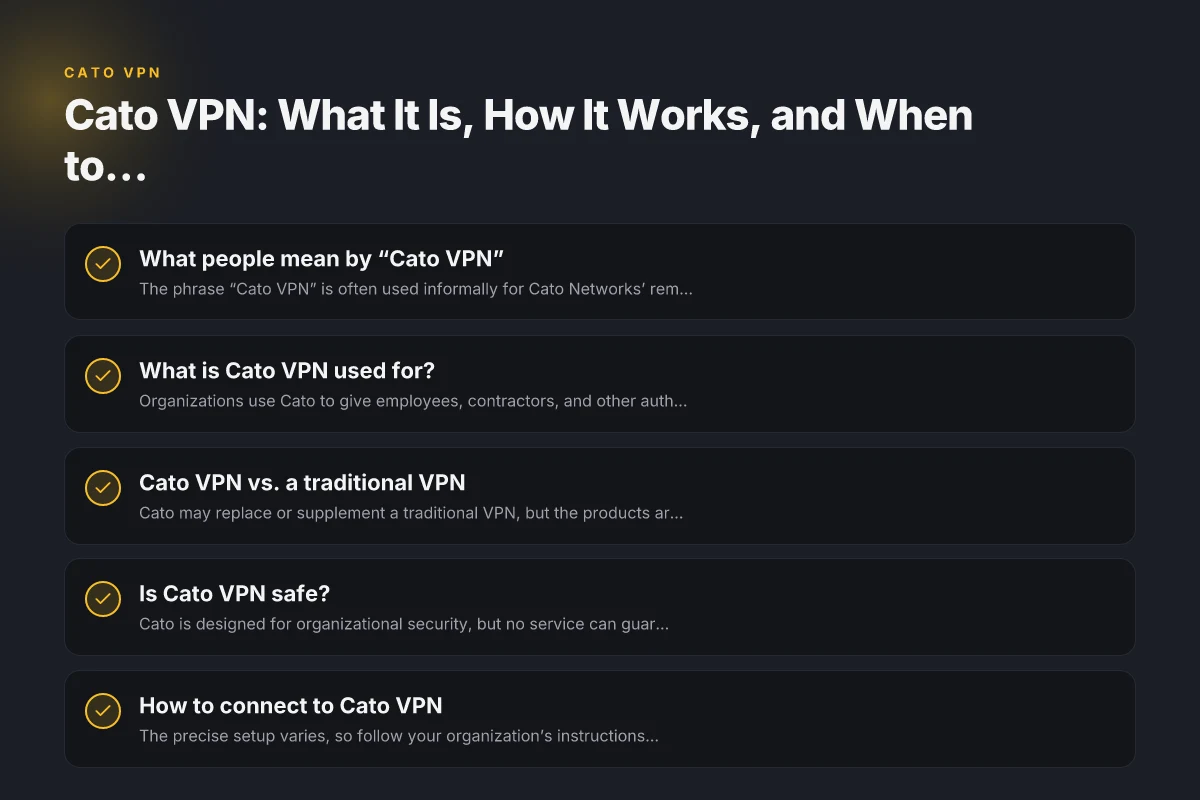
What people mean by “Cato VPN”
The phrase “Cato VPN” is often used informally for Cato Networks’ remote-access service. The company describes its Cato Client as a lightweight agent that provides secure, zero-trust access to resources on the internet, in SaaS and cloud environments, and on private networks.
That distinction matters. A traditional VPN typically creates an encrypted connection between a device and a corporate network. Cato can provide VPN-style connectivity, but its platform is designed to apply security and access policies as users reach different resources. In some cases, organizations may also offer access to private web applications through a browser extension for Zero Trust Network Access (ZTNA).
The exact experience depends on how your employer or organization has configured Cato. It may require an installed client, an approved identity provider, and specific permissions for the apps you need.
What is Cato VPN used for?
Organizations use Cato to give employees, contractors, and other authorized users secure access to company resources from different locations. Common use cases include: Free VPN for Edge: How to Choose and Use One
- Connecting remote workers to private business applications.
- Applying security policies to access to internet and SaaS services.
- Extending secure connectivity to cloud resources.
- Managing access for distributed users and sites through a unified platform.
Cato’s SASE platform combines networking and security capabilities in one architecture. For a user, that may mean signing in through one client to reach several categories of approved resources. It does not mean that every user automatically has access to every company system. Access is controlled by organizational policies and permissions.
Cato Client and browser access
The Cato Client is the main endpoint agent described by Cato Networks for secure access. Cato also lists a browser extension for ZTNA access to private web apps. These options are not necessarily interchangeable: your administrator decides which one applies to your account and which resources it can reach.
Cato VPN vs. a traditional VPN
Cato may replace or supplement a traditional VPN, but the products are not identical in approach. The table below gives a general comparison. Actual features depend on the organization’s deployment and policies.
| Area | Traditional VPN | Cato secure access |
|---|---|---|
| Main purpose | Connect a device to a private network | Provide controlled access to company resources through a SASE platform |
| Access model | Often grants network-level connectivity after connection | Can use zero-trust policies to control access to specific resources |
| Client experience | Usually a VPN app or built-in operating-system client | Often uses the Cato Client; browser-based access may be available for some private web apps |
| Resources | Commonly focuses on internal network services | Can include private apps, internet, SaaS, and cloud resources |
| Configuration | Set by the VPN administrator | Set by the organization’s Cato and identity policies |
A VPN connection is not automatically less secure, and Cato is not automatically the right fit for every environment. The difference is that Cato positions its service as a broader, integrated access and security platform rather than only a remote network tunnel. How to Add or Change a VPN Connection in Windows 11
Decide whether Cato VPN fits your needs
| Need or situation | Cato VPN fit | What to check |
|---|---|---|
| Accessing work resources remotely | Good fit if your employer uses Cato | Confirm your account is authorized |
| Connecting to a company network | Supported when configured by your organization | Ask IT which resources are available |
| Managing security for a business | Potential fit for an organization | Review its requirements and Cato setup |
| Browsing anonymously as an individual | Not its primary purpose | Consider whether a consumer privacy service fits better |
| Using a VPN without an employer or administrator | Usually not a fit | Cato access is typically organization-managed |
| Troubleshooting a work connection | Relevant if your organization uses Cato | Contact your IT team |
| Choosing a service for personal use | Compare with consumer VPN services | Check privacy terms and features |
Compiled November 2026; check the provider's site for current details.
Is Cato VPN safe?
Cato is designed for organizational security, but no service can guarantee that every connection or device is safe in every situation. Protection depends on the organization’s configuration, identity controls, endpoint security, and the user’s own practices.
For safer use: Edge VPN: What It Is, How It Works, and Which Option to Choose
- Install the client or browser extension only from an official source or a link provided by your organization.
- Confirm that you are signing in through your organization’s approved login page.
- Keep the Cato Client and your device’s operating system updated.
- Use multifactor authentication if your organization requires or supports it.
- Report unexpected login prompts or access failures to your IT or security team.
A work access client may route or inspect traffic according to company policy. If you are unsure what traffic is covered, what information is logged, or whether personal browsing is affected, ask your administrator. The organization’s policy, not the product name alone, determines how monitoring and access controls are applied.
How to connect to Cato VPN
The precise setup varies, so follow your organization’s instructions first. A typical connection process is:
- Get the Cato Client from the official Cato download page or your organization’s software portal.
- Install it on the device approved for work access.
- Open the client and enter the details requested by your organization.
- Sign in using your work account and complete any required identity verification.
- Connect, then open the company application or service you need.
Some organizations may use browser-based ZTNA access for private web apps instead of, or alongside, the client. Do not install a client from an unfamiliar third-party download site, and do not assume that a personal account can be used to access company resources.
If you cannot connect, check that your device has internet access and that you are using the correct work account. Restarting the client or device may help with a temporary issue, but repeated authentication failures, missing permissions, or a connection that never completes should be reported to IT. Administrators can check account status, device requirements, and access policies. VPN Edge: What It Does and How to Choose the Right Option
Check before connecting to Cato VPN
| Step | What to do | Who can help | If it does not work |
|---|---|---|---|
| Confirm access | Check that your organization uses Cato | IT administrator | Request access details |
| Get instructions | Follow your organization’s setup guidance | IT administrator | Ask for the correct procedure |
| Install the required app | Use the approved installer or method | IT administrator | Verify device requirements |
| Sign in | Use your authorized work account | IT administrator | Check your credentials |
| Complete verification | Follow any required sign-in checks | IT administrator | Ask about account or verification issues |
| Connect | Use the organization’s Cato connection option | IT administrator | Check the connection status |
| Open a work resource | Try the intended company service | Service owner or IT | Confirm your access permissions |
| Protect your account | Keep sign-in details private | You and your organization | Report suspected account issues promptly |
Compiled November 2026; check the provider's site for current details.
Who should use Cato VPN?
Cato is mainly relevant to people whose organization has deployed Cato Networks for secure access. It is not necessarily a general-purpose consumer VPN for changing your public location or choosing a personal privacy server. If you are an employee, use it when your organization requires it to reach work services. If you are evaluating it for an organization, compare its access model, deployment requirements, security controls, and operational fit with your existing needs.
Recommendation
Treat “Cato VPN” as a convenient name for your organization’s Cato secure-access setup, and confirm which client or browser option your administrator expects you to use. For work access, download it only through an official or employer-provided source and follow your organization’s sign-in and security instructions. Cisco VPN: What It Is, How to Set It Up, and When to Use It